


If I had to summarise the problem that everyone out there is facing right now, I’d probably do it like this:
How do we win when everyone is the same?
That is basically the rub.
Speed of iteration, low barriers to entry, AI compression, and everything else are squashing things together, leaving companies with barely any room to breathe. In the world of information and services, this is particularly extreme. But even in hard manufacturing circles, the same stuff is happening. I noticed the other day that the number one selling car in the UK now is a Jaecoo, a new Chinese entrant that is basically cheap copy of a Range Rover Evoque.
There is no escaping this force.
What most people don’t notice however is that we’ve been here before. The detail was different but the broader pattern of mass commodification was the same.
It happened in the mid 20th century when the primary locus of competition was supply - if you could make something at scale, then you could sell it. However as time moved on, the supply problem was eventually solved - screwing many companies that relied on that advantage.
But we all know what happened then. The market adapted. We evolved from an era of supply to an era of choice, where companies would compete to be the “selected option” from a sea of abundant supply. Features, benefits, positioning, brand; all these things became the new competitive weapons, and difference was restored.
So now that we find ourselves in a situation where those weapons are increasingly ineffective, and difference has dissolved once again, what do we do?
Well, we evolve again.
We have to move our weapons of competition to a higher level.
This idea of levels is extremely important, and is a universal competitive constant. Basically there are “lower” and “higher” levels at which you can compete. Lower levels are more obvious and basic, but quickly become exhausted when technology allows. Higher levels are more abstract and difficult, and so move the zone of competition “up” to more rarified heights where the majority of players can’t operate.
The simple example I normally reference for this is photography. A “low” level of competition is simply being able to do it (which is a supply-based strategy). If nobody has a camera and you do - bam - you win. Once upon a time things were like this, but when the technology became ubiquitous the level of competition had to move “up” - to the zone of who could use the technology well, or whose style you preferred etc. (choice-based strategy).
What is unclear however, is where we go next?
When the choice gaps are exhausted, the number of players reach saturation, and people are able to copy each other extremely fast, how do we go “up” from there?
This is the new strategic riddle.
And I know you’re facing it too.
Luckily, I’ve built a model to help you:
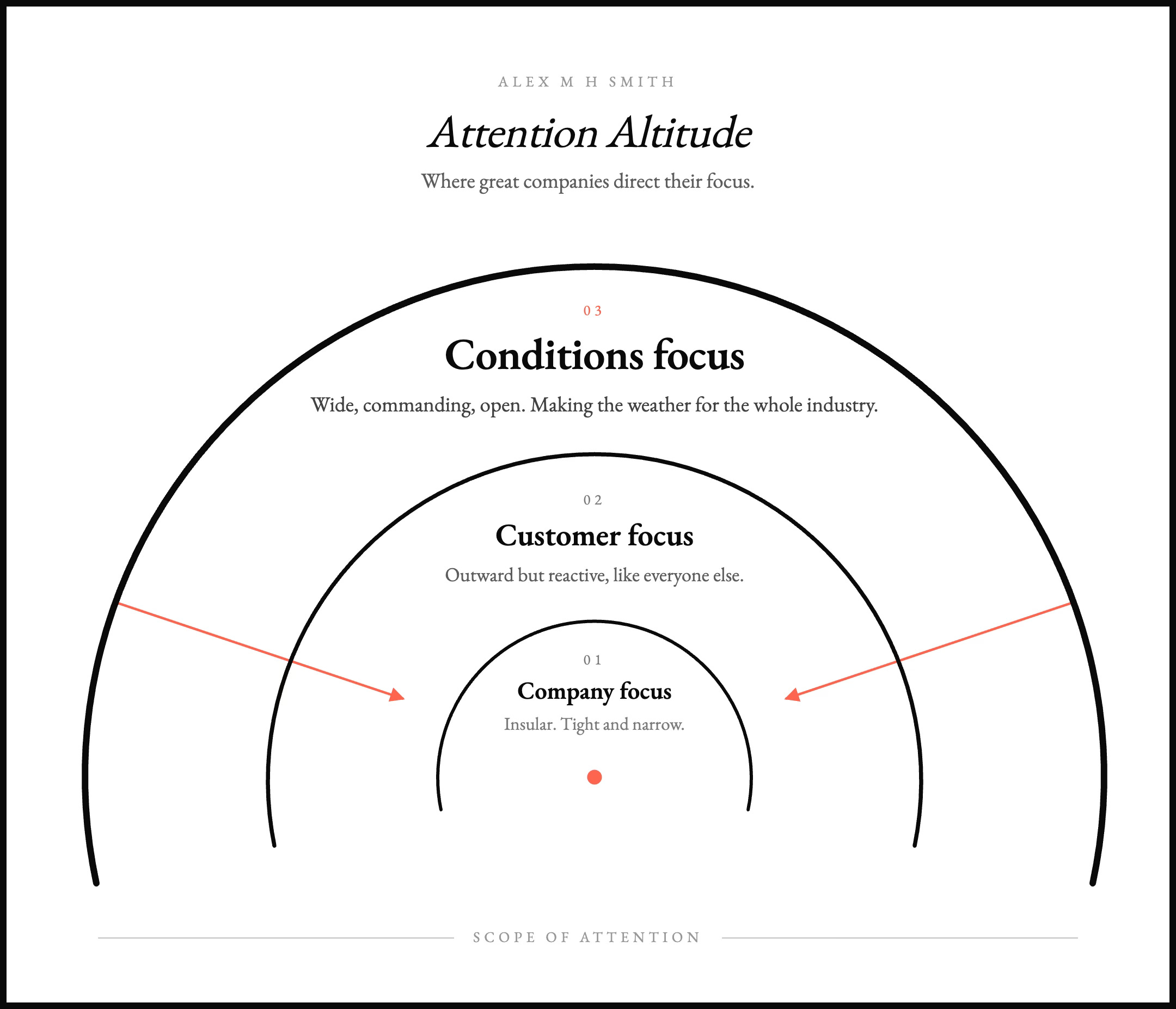
As you can see the concept here is one of “attention altitude”, quite literally a device to move businesses to a higher level of competition when the old one is maxed out. Our goal, basically, is to move our attention as much as possible to the highest outer ring, and as far as possible from the lowest inner ring.
Let’s run through it.
Level 1 - Company focus
This is the most unstrategic, low-leverage, witless place to focus your thinking. Unfortunately however it’s also where most of us feel the most comfortable. It’s nice there. Easy.
Here you are focusing inwardly to your company itself:
What do we want?
What can we do?
What issues do we have?
What are our preferences?
It’s the classic old-school supply logic, where whatever you can do, you can sell - which of course isn’t true anymore.
Leaders who operate at a level of company focus are your classic “working in the business, not on the business” types, who are all about day-to-day operations and internal dramas, and engage in almost no strategic thought at all. Not good.
Level 2 - Customer focus
Much superior to level 1 is level 2, where your strategic focus is on your customers and not yourselves. In the choice era, this is basically where strategy has lived, and where pretty much all semi-intelligent leaders have focused in the past 30 years.
Here you are thinking primarily about how to serve the customer:
What do customers want?
What are their problems?
Who are they?
Where are they underserved?
…and so on.
Until recently this was obviously extremely effective, hence why it’s been total business orthodoxy for most of our lifetimes. But, as we are now seeing, it is also a limited road. Eventually customers move from being “poorly served” to being “well served”, and at that point everyone starts “niching”, which often just means narrowing your addressable market to become more and more particular. Again, this is a good strategy for a while, but gradually the niches become smaller until they become self-defeating.
The other big issue with being customer focused, is that it’s inherently reactive. You respond to observable demands of the market - which is exactly what everyone else is doing too. You’re all asking the same questions, getting the same answers, and coming up with the same solutions.
This is why we now find ourselves in this “everyone’s the same” dilemma.
Level 3 - Conditions focus
You might be wondering how you could possible get above a customer focus, but you can - by focusing instead on the conditions and norms of the industry itself, and seeking to change them.
This is not a new or unprecedented way of operating - it was the standard practice of every legendary brand you can think of; Apple, IKEA, Google, etc etc. - but it is extremely unusual at a mass scale.
Here the leader tries to reshape the very way their industry works, and the assumptions that govern it, in a way that other players in the industry have to respond to (think about how Apple changed computing, or IKEA changed furniture, etc.).
They ask questions like:
What is wrong with this industry?
How might things work differently?
Where will it be in 5 years time?
What has nobody done before?
The aim here is not to answer customer expectations, but to fundamentally alter them in a way that everyone else must adjust to. In essence you are responding to the lack of space left in the market by rearranging it to create new space that wasn’t there before.
An example I like to give is what Trader Joes did in the grocery industry. They didn’t “create a new category”, as some might claim. Instead they questioned the norms of an existing category, to bring a new form of value to it that nobody had considered before. Better still, they did it in a way that was fundamentally incompatible with their competitors’ business models, thus giving them a huge amount of defensibility.
In this age of sameness, nobody has completely duplicated Trader Joes (yet).
Why this wins
Briefly let’s just look at what makes this higher game more effective in our current moment.
1. Most people aren’t doing it
This is very basic but worth noting - vanishingly few companies think this way. They are almost universally in level 1 and level 2. This simply means that the ideas you develop will have less competitive heat on them naturally.
2. It creates demand rather than answering it
In our current “demand crisis”, where there’s limited unanswered demand to be found, the only real way around it is to build that demand for yourself. You do this by showing the industry a new way of doing things that people want when they see it - even if they weren’t asking for it before.
3. It’s hard to copy
As the Trader Joes example illustrates, industry changing plays are inherently difficult to copy because all your competitors will have built their models based on continuation of the status quo. If you do it right it becomes hard to follow you without abandoning their current form of advantage.
4. It commands attention
As I’ve written about before, attention is the only resource which is growing more scarce, and so it’s the most valuable one we can have. With a conditions focused approach, you demand attention from others in your industry, which then accrues to advantages in hiring, fundraising, etc.
5. It’s hard
My old adage, and I’m gonna knock you over the head with it again: at all times, in all places, advantage accrues to those who do what’s hard and rare. Quite simply this is a more difficult, more ambitious game to play. And that, obviously, is why it works better.
___
A final important note is to say that a conditions focus does’t mean you abandon levels 1 and 2. They simply nest within it.
First you consider they way you want to change your industry.
Second you then consider what kinds of customers this would help, and what new value would be created for them.
And then third you think about how you’d need to change your company to deliver on it.
That is the order.
I beg you not to let yourself off the hook with this one. Don’t say “we’re too small to make a difference”, because that’s never true. The malleability of industries is inversely proportional to the size of players within them. What I mean by that is that hard-to-change industries tend to be populated by big players (e.g. automotive), whilst easy-to-change industries tend to be populated by small players (e.g. advertising).
So yes, a one-man-band couldn’t really change the automotive industry, but then there are no one-man car brands, so it’s irrelevant!
Whatever industry you’re in, you can influence it.
And best of all, even if you don’t succeed in doing so, the strategic thinking that arises from that higher focus will still enable you to perform better in the choice economy.
I’m confident, over the next few years, you will see that this is the way things work now. It’s gonna be rough out there for a lot of companies, and many of them aren’t going to make it, as existing demand consolidates under fewer bigger players.
Meanwhile every industry will have its conditions-focused elite to contend with - perhaps you can already think of some in your own.
The only choice left for you, is to decide whether you want to suffer the weather - or be the one to make it.
Fantastic as usual, Alex. Do you think a company could play level-3 with the way it runs ads? For example, I feel the fashion industry plays too safe in their ads in general. If a new brand then runs ads that are very provocative and mock the status quo of how people dress, would you consider it part of a level-3 strategy?
The answer is nobody is you.
Offer something and be magnetic. Connect give value. The hive sustains the useful and shiny. 😎 and kicks the useless boring in the hiney.