


Before we get into it, if anyone wants to snag one of the last couple of places in the No BS Consultants Club before the end of this week… now is the time.
OK, on with the piece.
___
Every single day, the emails come.
At increasing volume, increasing intensity, and with increasing specificity.
Would I like more leads?
Would I like my book to be promoted?
Would I like help with YouTube editing?
Would I like to turn my IP into products?
Would I like to set up a bunch of AI agents for whatever?
In actual matter of fact, I would quite like everything they’re offering. It’s all relevant, all appealing on paper, and all speaks to the reality of my business.
But do I ever reply to these emails?
Lol, no.
Obviously not. This is just bot spam - or that’s what I assume anyway - and it all goes on the dungheap of my deleted folder, along with the floods of very-good-but-entirely-unwanted email newsletters that I never signed up for.
Now it may sound like this is just me complaining about spam - which it is. But there’s something else far more interesting going on here too.
Because you see, based on everything we’ve been told about business in the past 5 years, I should be happy to receive these mails. I should be replying to them. I should be giving them my money.
Why?
Because they are often examples of perfect positioning.
I am exactly the right customer. And they’ve identified exactly the right problem. And by the sounds of things they have exactly the right solution for me.
And so by rights shouldn’t I want what they’re selling?
Apparently not.
Now I know what you’re thinking - I’m just ignoring them because of the medium; because they are spam emails. But this isn’t true.
The fact is that I see flawless positioning everywhere now.
I see it on landing pages.
I see it on LinkedIn bios.
I see it on DMs I receive.
I see it on CTAs from content I watch.
And even so, I never even feel a flicker of interest in all these “answers to my prayers”.
It seems to turn out that the right offer for the right customer actually doesn’t matter as much as we thought.
And you know what’s even weirder?
Many products and services I do want, that I do buy, don’t actually have any readily discernible positioning at all.
I mean maybe they do have it, under the hood, invisible to the customer. But they don’t wear it on their sleeves in the direct “we do X for Y type of person” kinda way that we’ve been told is best practice.
In fact, if we come to look at the majority of billion dollar brands, their positioning almost always seems quite murky to say the least. I look at some of these websites and think “who the hell is buying this shit?”. But loads of people apparently are.
How do we make sense of all this?
How do we make sense of this when the entire business community - particularly online - seems to have decided that if you get your positioning dialled in, it will act like a silver bullet to solve all your strategic woes?
Well, I’m gonna tell you.
But before I do, I just want to make clear that I’m not actually dunking on positioning here. It is important, and it is worthwhile. If you sell positioning, what you do matters. I regularly do positioning work with clients within a project. And if your positioning is all over the place, you should get that sorted out.
It’s just it isn’t actually a silver bullet.
And also, contrary to what many people seem to believe, it isn’t synonymous with strategy.
Now the reason positioning became so valorised in the past few years is extremely rational. Essentially people thought:
“If you offer people something that really fits their needs, they will buy it”.
Seems to make sense. And indeed, historically, this was broadly true. A few years ago, when bad positioning was totally rife, the few companies that really dialled-in on it tended to thrive. Indeed these are the case studies that the modern positioning mythology was built on.
But you see, a cognitive error was happening here.
You see, people assumed that the fact that companies with good positioning succeeded, was proof in the power of the positioning itself. But this was only partially true.
The bigger driving factor behind these companies success was simply the fact that their clean positioning made them stand out in a see of garbled mush.
It’s like, if you’re looking at 3 companies, and one of them is super clear and the other two aren’t, you’re gonna buy from the clear one aren’t you?
Clarity, in that world, conveys competence. Expertise. Something you can trust.
Now however we live in a world where garbled mush has become a thing of the past. And being able to be clear and relevant no longer implies any special abilities or authority. It just implies you’ve watched a bunch of YouTube videos and have access to ChatGPT.
As a result, positioning as a form of leverage, has lost its teeth.
This actually happens to all popular business techniques and memes, thanks to something I call the effectiveness curve, which basically goes like this:
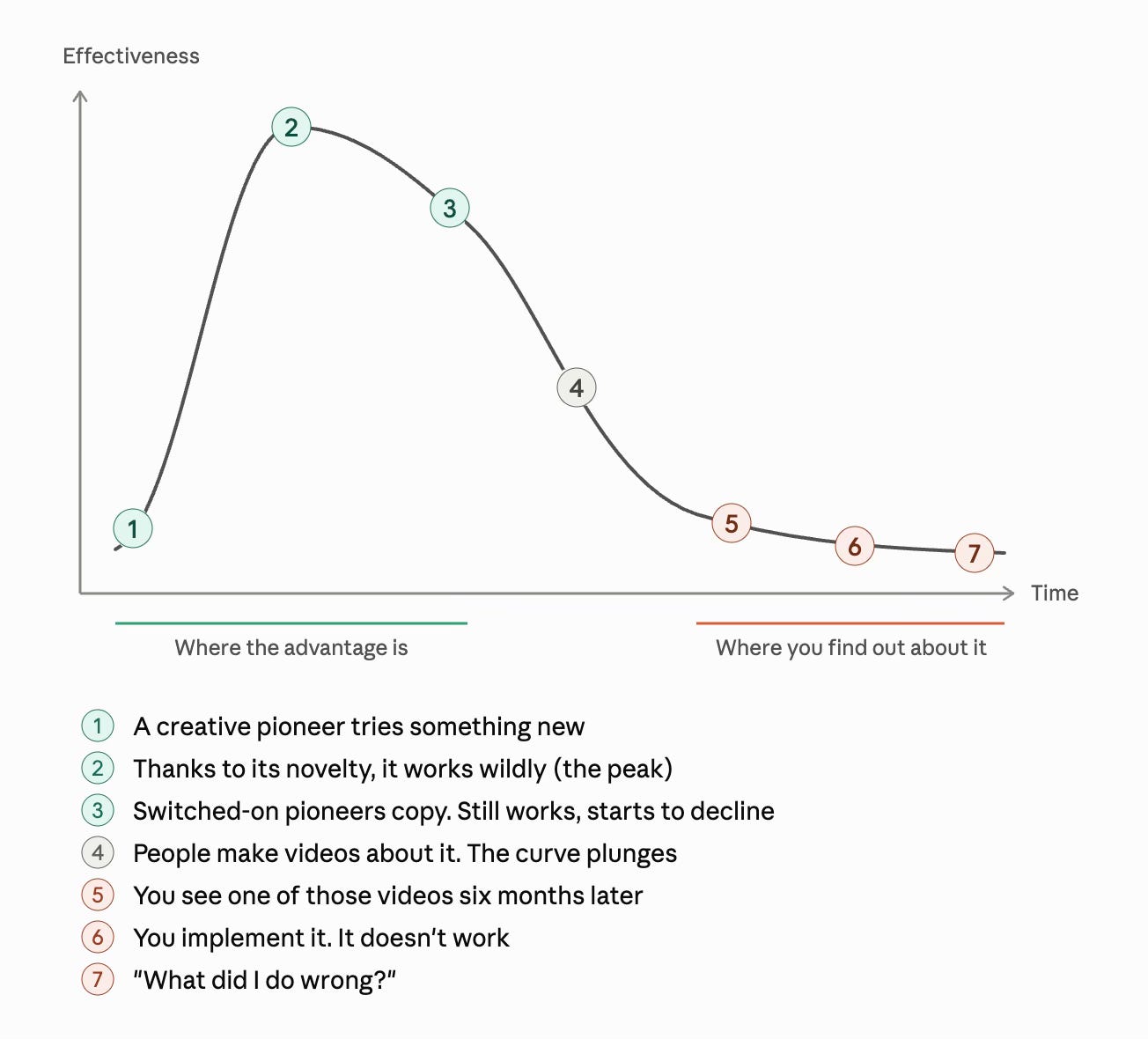
The entire business ecosystem these days has become people chasing silver-bullet-techniques at stage 6 of the curve, and getting confused as to why their perfect execution actually seems to make no difference to business performance.
Well it’s because it never was about any particular technique.
And contra to positioning-theory, it never even was about giving people something truly useful and relevant either.
It was always just about leverage. It was always about doing things at the beginning of the effectiveness curve. And that is why strategy and positioning are not the same thing - because strategy is the pursuit of leverage wherever it may happen to be at a given time. Whereas positioning is… well… positioning.
Today, at the tail end of 2026, I think positioning has become a necessary-but-not-sufficient part of the business toolkit. Something you should do well, but which you shouldn’t expect fix all your problems.
For that, my 2 cents are that you should be looking towards demonstrations of scarcity and power. You don’t want to be showing people you can help them. Of course you can. Instead you want to be showing people you are on the inside of something they desire - and they are on the outside.
Exclusivity and access are, speaking broadly, the antidotes to abundance.
And if someone emails me demonstrating that? Well, I may just reply.
Good positioning still matters, but only if it communicates that you are providing something uniquely valuable to a market (familiar words, right?) and your organization is actually structured to deliver on that positioning. But good positioning isn't enough without having built authority or an understood expertise - exclusivity and access / scarcity and power are all ways to describe authority or expertise in my opinion. The latter is how you get noticed and can influence the relationship and pricing.
I think you have misunderstood positioning.
Positioning is not about articulating what you do.
Positioning is about doing something that meets a customer need, an urgent customer need, and meets it in a way that no one else is meeting it. All those emails coming in meet a non-urgent need in an also ran way. Those are not well positioned businesses. Those are businesses that have used ChatGPT or Claude to articulate what they do better than they used to, but they are not well positioned. They are not differentiated. They are not doing something that everybody needs and nobody else does. They are not in control of a scarce and highly sought after resource.
Positioning is absolutely strategy. Because good positioning involves looking at what you offer, deciding if it's of interest to anyone, and if it's not, then changing what you offer to something that is.